Categories
Uncategorized

*

I was thinking about just putting together a few photos for my next Post…… you know, pretty pics of quaint villages and cobblestoned streets. That would be easy as there is an abundance of those types of things to see.

But then something happened.

It was innocent enough, just a day of travel between countries, specifically Latvia and Estonia, when Aida (our wonderful Tour Experience Leader) put the DVD that she had mentioned to us earlier into the player. Filling our time with meaningful experiences is an important part of her responsibilities and providing us with options pertaining to this concept keeps her very busy.

                     So just when we all were reveling in the thoughts of possibly taking a road trip ‘nap’, the screen pops on and the story unfolds.

                     This is where my job gets almost impossible, as it is in fact, impossible to go on without employing every cliché that has ever been uttered by every person on this planet that has wanted to be free from the tyranny that has never been erased from our collective histories.

                     I am begging you to stay with me here.

                     Most of us remember the fall of the Soviet Union, it was there before us on our nightly news programming, usually headlining the broadcast until something a little more ‘current’ (?) popped up for a day or two. The Berlin Wall had been pierced almost two years prior and to say that the Iron Curtain was getting a little too rusty would be an understatement. But that was Germany and while we all know how close East Germany was to the Soviet Union, the more lenient policies of Mr. Gorbachev and a few ‘mistakes’ made innocently enough by East German officials led to the Perfect Storm of events that allowed thousands upon thousands of East Germans to flood the borders and stride across the “Line”. They were unimpeded by both their own military and that of the Soviets who were all boggled up with a war in Afghanistan and an economy that was bad and getting worse by the nano-second.

                                So, the Stage had been set.

                                All that was needed were a few cast members.

                                But it took another two years before the Opening Night was to occur.

                     Let’s assemble the cast.

                     To do this we need to rewind more than a hundred years to an innocent enough singing festival that was held in Tartu, Estonia, then a part of Imperial Russia. It was held every five years and eventually moved to the larger city of Tallinn where it is still held.

Now we’ll fast-forward to the Soviet times when the singing of ethnic, ‘old-timey’, ‘get a feeling of the good ol’ days’, ‘wish it were like that again’ songs were, get this…… forbidden. In their place were inserted songs about Lenin, Marx, Stalin, and the greatness of socialism and the Soviet ways of life. You may ask, “Why then did the people participate?” Probably for the same reason that they all go to the polls to “elect” their dictator with a “unanimous” vote. Not to participate would make you stick out like that proverbial ‘sore thumb’.

                     So our cast has been assembled and every five years they would gather at a special outdoor stage. It is an incredibly large venue that can hold 15,000 on stage and another quadrillion (or so) folks around it.

                                Let the festivities begin!

                                The key song that both sparked and unified the then reluctant participants was “Land of My Fathers, Land that I Love” which you can tell just by its title was emblematic of the undercurrent of repressed feelings of a nation of suppressed people.

           When the choir first sang it (I would have loved to have been in on the planning of that one!) the officials ordered them to stop, but to no avail. They then ordered the orchestra to play loudly over them but (oops!) someone forgot that there were those quintillions of folks in the festival audience who were not going to let a few trombones get in the way!

                                Guess who won that one!

                                Here we go!

                                1987-1988 the Singing Revolution gains headway (complete with another strictly forbidden exercise) of the display of the Estonian national flag.

                                1989 – The Baltic Way, a 420-mile-long unbroken human chain that linked Lithuania, Latvia, and Estonia beginning at 7PM and lasting for fifteen minutes on August 23, 1989. Can you imagine the planning needed to accomplish that one!

                                Boom! September 1991 the full restoration of Independence of the three Baltic countries! YAY!!!!!!!

                     And that is ‘Restoration’ with an asterisk* because for all of recorded time, they were only independent for 22 years between the World Wars. Talk about perseverance!

                                                          ++++++++++                             

We are here.

We are here speaking with the people who endured the Soviet repression/suppression/whatever ‘pression’ you want to insert there.

We are here to listen to their stories.

We are here to see their incredible progress.

We are here to see the smiles on their faces when they speak of their good fortune.

 And we are here to see the sadness in their eyes when they relate the stories of their grandparents who they never saw again after they were sent to a gulag somewhere in Siberia.

Then Aida pressed ‘Play’ and nothing will ever be the same.

+++++++++++++++++++++++++++++++++++++

I invite you to watch this indescribable documentary on the unfolding of these events.

It seems to be available on several platforms, Apple, Amazon Prime, HBO max, and if they don’t work, there are several teasers around, google it or go to TheSingingRevolution.com for more information.

                                I promise.

Categories
Uncategorized

Medieval(?) Riga!

The view from our hotel window.
The Nativity of Christ Cathedral (1870’s)

I can hear the screams of anguish and despair already,

But have no fear or trepidation as the torture will last only a few paragraphs and several photos.

We are going back to Art Class for a few seconds!

Oh no Donny! Not that again! We’d rather a lecture on (God forbid) Plate Tectonics! Anything but that stupid Art Wrecko or Gecko or whatever it is!”

Nicely done Class, I can see we’re making progress, you were able to at least rhyme something correctly, but no we’re not looking at Art Deco again, but its relative, Art Nouveau. And there’s no better place on the planet than Riga to show examples of this style. Thankfully, Riga’s architecture was able to survive WWII mostly intact as the bombing was minimal and there was no systematic razing of structures like there was in Warsaw.

           So, you know all those cool decorations that are on some fancy old buildings? That’s them, that’s Art Nouveau. It featured the ‘organic’ aspects of life, flowing curves, plant-like florals, and a more modern take on our old friends from Europe, the gargoyles by incorporating lots of busts and faces. These were used at time in the same way….. they could stare at their neighbors with distain or be ‘reminiscent’ of a ‘message’ that the architect wanted to get across.

The period really only lasted about twenty years from roughly 1890 to 1910, and Riga is one of the worlds treasure troves of this type of architecture with over 800 buildings still available for perusal!

           No worries, I’ll show you just three!

The entire street!

           Now, that wasn’t so bad now was it?

Walking Tours of these cities is really the only way to discover the hidden gems within. Usually, the walk starts early in the morning and ends around lunchtime conveniently around the Main Square (which Riga has too many of!) and then we disperse for the real reason we all come here and I can assure you that as good as Art Nouveau is, it pales in comparison to a good eatery!

Hence this place!

Rozengrals

           Riga was an important Hanseatic trading city and as such, had the infrastructure to support it. You know, buildings that were secure, could hold a lot of important ‘stuff’. And were economical to store goods that need both that security and good, constant temperatures…. like a basement, or better yet, a cellar (almost the same but cellars sound much older!)

(The Photos are of a really dark place so best viewed in a darked environment!)

Yes, that is your ‘Greeter’ sitting at his table

                                This place SCREAMS as it is the real deal! These cellars, this one in particular, date back to the 13th century ….. that’s the 1200’s folks! In it would have been for the storage of grain, honey, flax, and other notable items such as salted fish, meat, butter, and cabbage. Imported luxuries, such as spices, nuts, and wine, were also stored there. They were quite secure I can assure you as even the present-day entrance to this tomb-like place was interestingly a steep (def non-ADA compliant!) set of stairs.

The Main Hall
This is the medieval version of ordering a “Coke”.!
It is Kvass, a fermented bev whose ingredients include stale, toasted rye bread, water, sugar, and yeast. The alcohol content is usually less than 1%.
It is a popular Slavic and Baltic drink, often described as a slightly bubbly, tangy, and bready tonic.
Paula, Harold, and Sherry.
The soups come in their own crockery bowl, complete with hot coals underneath them to keep them that way. Surprisingly, that ladle was very easy to sip the soup from.
Our period-correctly attired waitress delivering some really heavy soups to the table. Note the glowing coals under the bowl.
The puff-pastry lid of the onion soup,

                                Not much has changed today as meats, butter, honey, spices, and fish can all be found there courtesy of their medieval menu. And yes, we could be found there also…. not just once, but twice as we wanted to go back. And the more we talked about it with our comrades, the more they wanted to join us. Aida wanted to check it out for future tours to visit, and it got an enthusiastic ‘thumbs up’ from her! I wonder if we can file for future ‘commissions’ on the sales 🙂

Categories
Uncategorized

Crosses and Missiles

We went to a Cold War Bunker yesterday, and this sign was front and center. Apparently, they had the same issues we did as it read:

Remember, Only You can Prevent Freedom! (or Forest Fires!)

(Or something like that. Story in a few minutes.)

This entire area has gone through so many political boundary and ideology changes in the last few hundred years that it makes them a card-carrying member of Borders-R-Us. Through it all, Lithuania has tried, with very limited success, to declare its independence from whomever has the yoke around their necks at the time.

Usually, it’s the Russians.

1831 was no different, except that now it also involved the defunct Prussian entity. Men went to war, families stayed home, and men did not return thus.

A small ancient ‘fort’ located on a hill in Lithuania became a memorial of sorts as families who could not locate bodies of their perished rebels, started putting up symbolic crosses at the site of the former hill fort. Over the generations, the place has come to signify the peaceful endurance of Lithuanian people despite the threats they faced throughout history. Loved ones continued bringing crosses to the Hill in memorial.

           The practice grew, the people embraced their idea of a place to erect a cross in memory of someone or in hope of something,,,, the Hill grew too.

All is well and good in The Hill of Crosses country until the Revolution, the big one, the one where the Czars were made candidates for the Hill themselves, the one where Lenin and the Bolsheviks rose to power, and it was the year that Communism became synonymous with Russia…… 1917.

                                Communism and organized religion don’t get along.

                                Fast-forward to the Soviet occupation starting in 1941 which ended the Lithuanian’s brief dally with Independence that it claimed when that 1917 event shook things up for a bit.

Oppressed Catholic Lithuanians and communists don’t get along either.

                                The Hill of Crosses becomes a symbol to both, and to both, was as important as it could be. Three times the Authorities (including the KGB) try and remove it. They used bulldozers, troops, and even thought of flooding the land…. nothing worked. Every night the Faithful would risk punishment severe in order to fulfill what they now considered a Sacred Duty……. Keep the Crosses coming.

                     You all know what happens….. I don’t have to tell you who won, the fact that we went there is proof enough. Pope John Paul II went there in 1993, said that it was “a place for hope, peace, love, and sacrifice.”  If a visit from a Pope and an affirming statement doesn’t solidify your place in the world, I don’t know what does!

                     The Hill has grown into The ‘Field’ as they have now worked their way down the sides and into the fields on either side. There are numerous trails that meander through the plantings making it easier for someone either to visit an old one, or find the perfect place for a new one.

                     The parking lot is across the street; a long walk needs to be accomplished before you may step onto the Hill. Happily, no one has started charging admission although there is the obligatory “Book Shop” (aka souvenir stand.)

That was the second stop of the day.

Yesterday we traveled from Klaipeda in Lithuania to Riga, Latvia. It took all day mainly because we made it so, stopping there at The Hill of Crosses and an old Cold War site.

 Our first stop was at a disassembled ICBM missile site straight out of that Cold War Era. In fact, that was its name….. The Cold War Era Museum and Missile Silo (roughly translated!) Inside we saw what was ‘what’, and where that ‘what’ was located, and how and why the ‘whats’ were there,,,,oh, and plus how many ‘what’s’ there were.

                                Confused?

           Well, all of this was a ‘re-creation’ as nothing was left after the fall of the U.S.S.R. Military posts were abandoned, locals came in and ransacked the place, absconding with anything that could be of value. I wonder how many homes in the area boast electricity upgrades courtesy of the miles and miles of wire pinched from there! Generators, tiles, lumber, desks, pencil sharpeners, 😊you name it and poof! it was gone!

On the way in, the camouflage concrete “grass grows through it” blocks
Main underground room ahead, four silos surrounding it
Top of one silo
Propaganda posters
Comrade Paula inspecting the silo

           Apparently, there are only three sites in the world that are now open for public inspection….. this one, one in Arizona, and one in Ukraine. We’ve been to two out of the three and I don’t think we’ll ever get to Ukraine, so we’ll stay put at two. FYI, if you ever go to Tucson (which makes a fabulous get-away anyway!) check out the Titan Missile Museum, it is definitely worth it!

That guy looks suspicious……
Categories
Uncategorized

Tales from the Lithuanian Woods

I can tell that your detective skill set is on High Alert as we venture further to the North. Several Captain Obvoius-like observations as to our change in dress shows me that I can’t get anything past you guys! Yes, the temps have plummeted, and those Accoutrements of Activity (Outdoor Department) have found their way out of the suitcases and onto our hands and heads. But have no fear! Neither rain, nor wind, nor snow, or gloom of night can keep us…. Well.…maybe Gloom of Night, no one likes that! And as you will see, there are Tales of Nere-do-Wells afoot, and I can feel them breathing down my neck.

Unbeknownst to me not only was this guy giving me the eye, but Paula recognized a good photo op when she saw it!
This will be my Christmas Card photo.

                     There were several activities over the past two days that dealt primarily with old lifestyles and folklore. As the homogenization of our species continues to march forward, folks around the world are scrambling to ensure that their “story” is set down somewhere so that it can be told over and over again in the future. It is the wise culture that has this process already underway and is now just fine-tuning it to meet today’s standards.

                     Someone may ask why this is so important and that answer is not that obvious as the need to know and remember these types of things waxes and wanes with whatever is going on in one’s (or society’s) life at the time. But I think that it’s easy to simplify the answer and make it personal….. who doesn’t like sitting around with your grandparents and listening to stories of the ‘olden days’ and especially those about your parents! It is the wise family that keeps this tradition moving forward, enhanced by the modern ways of documenting these tales before the sources of them wither away forever. There are still questions that I have for my Mom that I wish that I had answered, or photos identified, before she was no longer there to ask.

                     It seems to be a little more important over here than back in the USA. That’s not taking anything away from our stance, it’s just that the stories over here can go back hundreds of years farther than ours do, and when you couple in the fact that in the relatively recent past, individual cultures have sustained incredible attacks on their very existence by overlords of repression…. well, this certainly does help hasten the need for providing vehicles for the survival of their tales.

                     The bulk of the last two days were spent witnessing such efforts. Here in Lithuania, a country whose heritage throws back to Baltic Tribes settled in their own little enclaves, the drives to keep the stories from being obliterated (even during Soviet times) started decades ago and sometimes needed to be disguised in order to survive. For example, unless you are “of” the people you’d have no idea what was being saved by the people because taken out of context, a fable just seems an innocent child’s tale. I am happy to report that these people’s stories and heritages seem to be firmly ensconced within both the actual and virtual walls of their assigned institutions.

                     One of the more enjoyable aspects of listening to these tales is finding out that no matter where you go there is a Princess waiting to find her Prince, a witch looking to thwart anyone’s plans, trolls aplenty just itching for a fight and a Souvenir Shop happily disguised in order to lure you in!

                                Here you go!

Way back in the early 20th century the Lithuanians started collecting the buildings and homes of the various types of folks living around there. They eventually garnered several hundred acres in order to make a gigantic open-air museum and historical park.
These are all authentic, just collected from around the country and deposited here for all to experience.
Folk songs!
This guy had a great voice! he taught us one of those ‘repeating verses’ songs like “Row, row, row, your boat…..”

The Witch’s Hill

An attempt to keep the Lithuanian Folktales alive (when they were threatened by Soviet repressions) back in the early 1970’s these carvings were commissioned and then rendered. They have been lovingly cared for since then! There are about 80 carvings, here is just a small sample of them……

Our Guide for the day had a personal attachment to these giant carvings as her dad was one of the first organizers of this exhibit. She’s holding a photo taken on Day One back in 1971 of this carving to show that it is original.
Fishing is the primary industry in this area and has been for centuries.
How many tales of women waiting for their men have been told over that expanse of time?
Think you can lift the ‘axe’ from the log?
There’s always someone to let you know which way not to go!
Watch out for this guy!
Details, details…..
Our Mid-Hike snack…. sausages, cheese, rye breads, pickles (homemade!) and of course, some whiskey!
Recognize the guy at the end? he’s the one holding up the bench and looking over my shoulder in that first photo!
Of course, when one has successfully survived the gauntlet of The Witch’s Hill and all of the demons and tales, you must expect a Party at the end!
With some musicians!
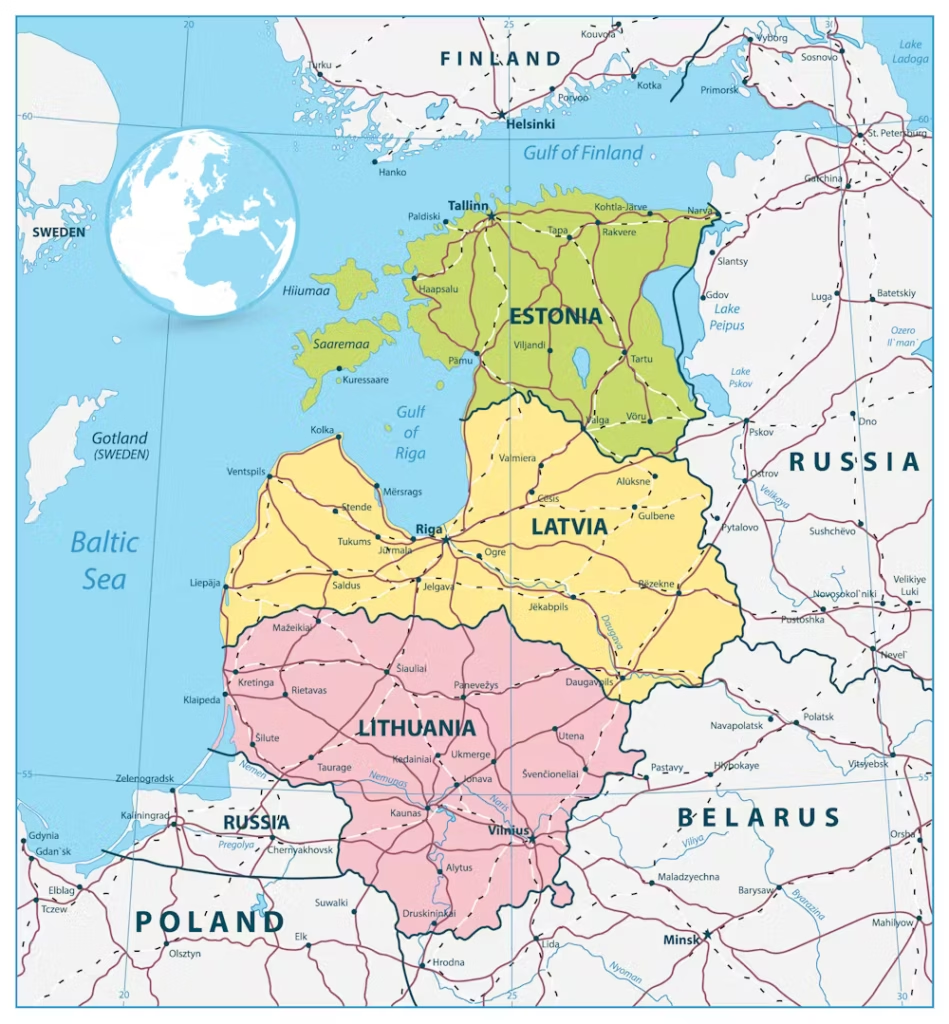
The Witch’s Hill is located on this barrier island which in turn is a small part of Russia! That spit of dark land on the left is in Russia. See the map below.
Traditional methods of building are still being incorporated here. Check out this reed ‘thatched’ roof with a life expectancy of over sixty years!

Folk songs….. folk tales……. there’s no better way to hear and see them than from people integrally involved with their keeping them alive!

Categories
Uncategorized

The Ugly, the Bad, and (finally)the Good!

I feel like I am back in school.

There is “paying attention” needed on an hourly basis, from geography to history to religion to ethnicity to culinary, if one does not keep up, then, that one gets lost.  

                     Having posted that thought, I will retreat from it and confess that this activity is not a chore! The presentations are an all-encompassing series of events designed to lure that old reluctant student out of retirement and smack them in the face with all things stimulating,,,,, and important.

                     We are still in Vilnius for one more day and that day contained several wildly different aspects that somehow all seem to make sense when combined. I believe that it is that way because learning about people(s) and places needs to have that well-rounded aspect that can only come with all of the boxes being ‘ticked’ that I listed in my first paragraph.

                     So, get ready, I did the “paying attention” for you and I’ll provide you with the Cliff Notes version, and you can feel free to just ‘audit’ this class, no exams needed, but…. I do encourage you to enroll sometime because the Class Trips are something quite extraordinary!  

                     Our day started at the old KGB building right down the road from our hotel. Yes, that dreary, Cold War, Boris and Natasha, Spy vs Spy, James Bond, Man from U.N.C.L.E. experience has a real-world genesis, and its name is Komitet Gosudarstvennoy Bezopasnosti or the KGB. And it is as sinister as its hard-consonant name sounds.

The victims, most are guilty only of being human.
I know that it’s a grisly way to start, but I’m afraid that these are the representations of the facts.

                                We had a private tour of this facility which is now dedicated to the Freedom Fighters that helped make the downfall of the old Soviet Union possible. Our Tour was led by a gentleman who had the opportunity to delve through, and bring to the surface, old KGB evidence that spoke to the incredible evils that occurred within the walls of that facility. We saw detention rooms, solitary confinement cells, padded cells, and even the execution room where everything was so planned out that there was a drain in the floor for the blood and a special window chute to hoist the body through.

Cell
Bathroom
Corridor with many cells
Stairway to Hell

On one level, the scariest part was a giant map of the U.S.S.R. that showed hundreds of like facilities strewn about that vast area, that accomplished the exact same thing that this one did…. strike relentless fear into the populace with the express intention of keeping everyone contained and controlled. The Guide was very convincing…. as I had mentioned, he had a personal role in this building after the fall.  Anyway, he came across as a cross between Boris Karloff and Rod Serling, an effective communication combination I am sure you’ll agree.

Our Guide, Richard
Boris Karloff (you decide!)

                                The numbers associated with all of the fear and trepidation of the KGB are staggering in their own right. In the initial occupation by the Soviet Union back in ’40 and ’41, over 23, 000 citizens were either imprisoned, deported or killed. The next era, which ended with the death of Stalin, saw close to 400,000 ‘suspects’ being treated to the same fate.  You did not need to go to trial to get convicted, all you needed to do was look suspicious and have someone rat you out for listening to Western music (for example!) and wham! Into this hideous torture chamber you would go! After Stalin died, things got a little more lenient with only about a thousand people being ‘processed’ through this system here in Vilnius. That old building, along with the monsters that worked in there, were quite efficient as you now see. The fear of being ‘eliminated’ had been the most effective implement in their toolbox.

Traditional house in Trakai.
Please note that there are three windows facing the street. Each window is for one of three entities, God, The Grand Duke (who brought them here centuries ago) and their family.

                                We then boarded our bus again for a trip outside of Vilnius to a beautiful lake region town named Trakai. This is where it starts to get interesting…..  there we found a very small enclave of a very small population of a very small religion. We met members of the Karaite community, a ‘sect’ of Judaism that has its own beliefs in how they interpret the Torah. They are not interested in anyone else’s ‘explanation’ or interpretation of the Torah, so they reject the traditional Hebrew study guide (?) of the Talmud. This is the main difference between them and Rabbinical Judaism. Definitely ethnic in origin, they trace their roots back to remote regions of (Crimean) Turkey where in the late 1300’s the Grand Duke of Lithuania persuaded some of them to leave the area and come and be guards for him in Lithuania. Away they went and now six-hundred years later a handful are left, some still 100% Karaite, living in Trakai. We not only met them, but we learned how to make one of their traditional dishes, Kibinai (think empanadas) which was in fact delicious!

Yes, we met these fine folks!
And not just their cardboard cut-outs! This is the family that owns one of the most successful restaurants on the lake and during the season, this area is jam-packed with visitors from the surrounding areas.
They are holding tray of Kibinai, their claim to fame and deservedly so!
Paula’s creation, mine was not fit for its public display.
We each were provided with an apron and a hairnet and then lined up in front of a workstation
Uncaptioned
Our Taskmaster, Grandmama
The “Line” with Aida showing off her creation.
Our illustrious group!
The castle of the Arch Duke who brought the Karaites to this area.

                     Again, I could bore you to tears with the historical intertwining of these folks and their journeys out of ancient Egypt and their diaspora up and through Asia Minor and finally into Europe so…. I’m not going to do that! Rest assured it is a fascinating story, one that is worth investigating on your own, and it bears witness to being one of the fundamental traits of traveling with a group who revels in learning about the peoples of the world…. and eating their snacks!

The local ‘kenesa’ which is like their synagogue.
Categories
Uncategorized

Vilnius?

Where we are!

                     “Ok, everyone please point to Vilnius on your maps.”

                                (Crickets)

                     “Hmm, ok how about pointing to the Baltic countries.”

                                (More crickets, and a few Spring Peepers)

                     “Well then, let’s get out that big map and get everyone going in the right direction! Timmy, show me where the Baltic countries are located please.”

                                Timmy points to a definitely veiled area in an attempt to hide what he is sure might not be quite the correct answer…. he doesn’t have a clue. He’s thinking Baltic Avenue.

                                “Congratulations Timmy, you’ve managed to point to the map.”

                                “But did I pass GO and can I get my $200?”

                                “Wrong game Timmy, now go and take your seat back in Marvin Gardens,”

                                Now not only are the crickets and Spring Peepers making noise, but they are joined by the now inordinately loud ticking emanating from the clock on the wall.

                             +++++++++++++++++++++++++

           We had a meeting this morning with our now entire Group. The pre-trip to Poland is behind us, and the Main Trip, The Baltic Capitals, has begun. There were three folks that joined us this morning for the rest of the two weeks of the trip. Our Tour Leader, Aida, (the ‘Phil’ of this trip) went over the various points that she wanted to emphasize to us. One of them was that on this trip we will not be visiting Bosnia.

                                Which is in the Balkans.

                                Not the Baltic.

                     Apparently during one of her past initial group meetings some guy asked when they were getting to Bosnia.

Oops! Wrong trip!

You say to-may-to, I say to-mah-to!

So, where is Vilnius anyway?

I will confess that I didn’t know!

This part of the world is a mumbo-jumbo of seemingly alike sounding countries that have boundaries that get moved and swapped with reckless abandon at the whims of geopolitical forces that keep mapmakers as busy as they can possibly be, never mind throwing in those other “B” places….. the Balkans!                                       (Yes, that was one sentence and Mrs. Tee, my 7th Grade English teacher, is probably not happy!)

           Vilnius is the capital of Lithuania, and I know that you’re probably sick of me writing this, but it couldn’t be cuter, or nicer if it tried! Old city, new city, medium city, it doesn’t matter, this place is great! English is almost the second language as it is taught from the Second Grade on and they need to pass an exam to continue on in school, so communication is not a large issue. It’s as clean as it can be, no litter, no graffiti….and quaint cobblestone streets (even the newer ones!)  

This is the Main Drag in front of our hotel.
Note the makeup of the street pavement!

                     We will be visiting Lithuania, Latvia, Estonia, and Finland. The first three are contiguous, with Finland just a ferry ride across the Baltic Sea. The first three were also part of the old U.S.S.R. and if you don’t think that they are scared to death with what’s going on in Ukraine you would be badly mistaken. There are signs of solidarity with Ukraine wherever we go, and these countries have pledged support, both militarily and financially, to their friends in Ukraine. It’s kind of a ‘All for One, One for All’ situation.

                     They all remember what it was like under the control of Moscow and no one wants to go back there!

           What’s fascinating about these small regions is that they all have their own languages and customs. In reality, they are no larger than a few of our States. For example, Lithuania and Latvia are the size of West Virgina in area but speak a different language than the folks in (Maryland) and (Virginia) and Estonia is around the size of New Hampshire or Vermont. All of this can be traced back to the old pre-Germanic Tribal days with so many different reasons why they were easily kept separate that it would take an entire semester and then some to get familiar with the nuances of the roots and differences of all of them!

                                We’re not going there!

                                We’re just happy that they all have some nifty and delicious regional foods to sample!

                     We had a walking tour of Vilnius yesterday; it could not have been a nicer day as you will soon see. Gorgeous blue skies, great contrast, beautiful colors…. Incredible architecture…. a photo-takers dream!

                                I hope that you enjoy your tour!

Below you will find an assortment of photos, some identified, some not, because in some cases it just doesn’t make any difference!

At the University.
Part of the ‘Old Walls’ of the City
Yes, café’s are everywhere!
Steeples are everywhere also!
A shop in the Old Town
As you may expect, there is a myriad of medieval-type small lanes meandering through the Old City.
This is a window (truck is a reflection) of an establishment nearby. I believe that this bears further scrutiny and a full tasting report in order to come to an honest opinion about this claim. Report to follow.
Last nights “welcome Dinner” consisting of local favs.
Here is a Cepelinai or Zeppelin. It is a large, oval-shaped potato dumpling stuffed with minced meat, cheeses, or mushrooms and boiled. The side contains the ‘sauce’ which is bacon cracklings and sour cream.
This what’s called Saltibarsciai or just Pink Soup. It is made from beetroot, buttermilk, cukes, dill, chives, and hard-boiled eggs. It is served cold and is quite good!
Categories
Uncategorized

Warsaw!

Part of “The Barbican” the original walls of the medieval part of the city. The rest is all re-constructed.

“Why are we going to Warsaw anyway? All it is, is a modern city. They just cleaned out the rubble and put buildings back up after WWII. New ones! No character! Boy, am I happy that we got to see Krakow! At least that one is all original! I’m glad we really only have a day and a half in Warsaw, any more would be a waste of time.”

                             Don Hall (3:00 PM – April 17, 2026)

“How come we have to leave so soon? Only a day and a half to explore Warsaw? Who planned this mess? An old KGB guy hired by Krakow?  C’mon let’s mutiny! They can’t make us get on the bus!

                                Here we go… War-saw! War-saw! War-saw!”

                                     Don Hall (9:30 AM – April 20, 2026)


                     “What a difference a day makes….”

                     Holy Smokes was I ever wrong!

                     (For the next few minutes [two minutes and thirteen seconds reading normally to be precise! ] I will bore you with a short history lesson, but it is crucial to what you are about to witness!)

           If there ever was a city that could claim the title of being a Phoenix, this incredibly beautiful city is it. During its long history, Warsaw has seen itself ‘completely’ destroyed and rebuilt not one, not two, not three, not four, but five times! We’ll talk about the two most significant of those sieges, the first being by the Swedes (yes, those Volvo / Ikea loving folks!) in 1655 – 1660, when they destroyed the city to the extent that 90% of the population was decimated and most of the buildings razed. The next are closely related by being contained within the confines of WWII. The first of these was in 1939 when Germany invaded Poland in September. As per the usual modus operandi of the Germans, all the Jews were moved into a ghetto and confined for further processing. Next came the infamous date of April 19th (check your calendars and note where we were yesterday, and the date). This date marks the start of the Warsaw Ghetto Uprising which although ultimately ended in defeat, took almost a month for these incredibly resilient fighters to succumb. After the Jewish resistance in the Warsaw Ghetto rose up, Nazi forces systematically razed the district, using flamethrowers and explosives to turn the area into a wasteland. This destroyed an additional large part of the city center. Next, during the 63-day Warsaw Uprising by the Polish Home Army, roughly an additional twenty-five percent of the city’s buildings were destroyed in active combat. By now the Germans had had about enough of these strong, challenging people and following the surrender of the uprising, German special units systematically burned and blew up the remaining districts, street by street, building by building, including historical landmarks and residential areas. That operation completed the destruction of what once was one of the most beautiful cities in all of Europe having once been known as the “Paris of the North.”

                                Yesterday was April 19th, the 83rd anniversary of the 1943 Ghetto Uprising. We were there for the commemoration, which has turned into a celebration (and rightfully so!) of the heroic resistance of a people that refused to give up. We stood outside the restaurant that we were to have lunch in so that we made sure that at precisely noontime, we could hear the sirens wail for the Minute, reminding all of the sacrifices made by those in the Past for those in the Future. And if those sirens didn’t remind everyone of an air raid siren, I don’t know what would.

                                So, now basically no more Warsaw. The Red Army moved in and ‘liberated’ this area, and I write that with ’tongue in cheek’ because while they may have liberated Poland from the Germans, it would take an additional 45 years for them to ‘leave’. (1989!)

Meanwhile, since Poland was liberated by Stalin and his Russian troops, they were not eligible to be included in the Marshall Plan which helped any of the countries that were freed by the non-Russian Allies. Even West Germany benefitted from this plan to help get Europe back up and running again.

                     (End of History Lesson)

           That was kind of necessary for you to appreciate what will soon be in front of you, a collection of photos that defy explanation except that now you know the makeup of the Polish people and if they won’t let a few fights get in the way, they’re certainly not going to let anything else get in the way of restoring their beloved city! Obviously, everything that you see will be post -WWII but it was reconstructed so well that eventually their efforts were awarded an unprecedented inclusion as a UNESCO World Heritage Site! Yea, there was some controversy there, but hopefully you can agree that after witnessing the outcomes, it is/was well-deserved!

Now for the proof!

I could just show you this, stop here and say,
“I rest my case!”
but there’s lots more to show about Warsaw!
Krasinski Palace constructed between 1677 and 1683. Heavily damaged during WWII, it was reconstructed latter- 20th century.
Myslewicki Palace – 1774-1779
The cool thing about this place is that it was the site of talks between the People’s Republic of China and the United States! These were held in secret during the years between 1958 to 1970 and since no one trusted the Soviets, no words were spoken, only notes passed between them and then burned!
Hooded Crow
Red Squirrel –
No not a Communist Squirrel, just his color!
More “Re Construction.”
As of the past few years, we’ve been to countless medieval/classic type cities that look exactly like this!
What’s a European city without a good outdoor cafe?
This is one of about 15 billion café’s here!
When the reconstruction began, they tried their best to incorporate as much of the historical “fabric” as they possibly could. Here you can see bullet marks in the supports for that upper story.
One of the monuments to the Home Guard fighting during the Warsaw Uprising.
Check out that doorway in the corner.
Since taxes were levied according to the front width of one’s property, this enterprising person just built out behind his small “front” door!
Mid-day, people starting to come out for a bite, to roam, and for the festivities.
Lots of Amber in this area!
Our lunch spot on the Square, that’s our table in the next room.
The room could not be more authentic if it tried.
The view outside to the Square.
The view inside at the table!
Window decorating really adds to the charm of the streets, one is better than the next!
More “reconstruction”.
Can you tell when this was built?
Another Square, this one was the site of the Main Event of the Commemoration of April 19th Uprising Day
After that Main Even concluded, the populace used the day for other events and protests. This one was a Right to Life one.
Guess what this guy sells?
I couldn’t resist!
Warsaw Celebrated!
(photo courtesy of Paula who had the patience to wait until no one was around!)

I hope that you can see why I was o mistaken in my judgement about Warsaw! That event ended our Pre-Trip to Poland, on to the Baltic capitals, the Main part of this trip. I can say that without a doubt we could go back to Poland and spend an inordinate amount of time!

Categories
Uncategorized

A Ghetto and Synagogues

Building in the Old Jewish Quarter

Our last day in Krakow was spent exploring the old Jewish Quarter and the Ghetto, along with an experience at the site of Oskar Schindler’s factory. The story of the Jewish people is nothing short of fascinating on any scale. For today, this will focus on one small city, Krakow, Poland. The smaller city of Kazimierz, directly adjacent to Krakow, was the site of the newly established Jewish settlement in the 14th century. Eventually assimilated into Krakow proper, it became the Jewish Quarter, and eventually part of the Old Town as the city grew.

Same

Enter the Nazi’s with the invasion of Poland in 1939 (the beginning of WWII) and we find that the planned extermination of the Jews needed a little more ‘organization’. The residents of the Jewish Quarter were then moved to a ghetto on the other side of the Vistula River in the Podgorze district where they were quarantined or, in fact, ‘sealed’ in. They were told that they were to be transported to the East for relocation purposes. They were sent to the East, but we now know what was located there.

Jewish cemetery, left undisturbed during WWII
Saturday morning
Windows

The term Ghetto has had several meanings since its genesis in the Venice in the 16th century. Back then, a “gheto” was a foundry and as such, not located in a desirable part of town. In 1516 the Venetian authorities decreed that all Jews must live in this rather confined area. Obviously, we now use the term ghetto to describe just about any segregated, impoverished area of a town where people are ‘confined’, and as a place where they in fact live. The Germans used these locations as a formal area of confinement before transporting the Jewish people to the camps.

Because Krakow was relatively undisturbed (artillery and bombing) during the war, all of the synagogues that were in the old Jewish Quarter were still there after the War and thus became usable again as the Jews started to move back into Poland. The oldest was built around 1494 and is still there, now serving as a museum. We saw several synagogues on our tour and as it was the Sabbath, there was activity surrounding them.

Call to worship
Old synagogue

After our walk around the old Jewish Quarter, we went across the river to the Podgorze neighborhood where we visited two important places. One was the square in the middle of the ghetto where the Jews all gathered, waiting to be transported, they brought with them all things important, even furniture. This is symbolized by these random bronze chairs placed in various positions around the square, empty they are, further symbolizing the fact that no one would be home to use them anymore.

Chairs in the Square.
This one frames the apothecary on the corner operated by Tadeusz Pankowicz who helped the Jews in spite of the possibility that if he were found out he would have been killed himself.

We then worked our way out of the Ghetto to the site of Oskar Schindler’s factory. This site is now being used as a full-on experience illustrating the path of what was to happen to Poland after the German invasion of 1939. It was a kind of multi-media production, very well done, that would be hard to show any kind of pieces of as they would need to be taken out of context and thus rendered ineffective, so for that reason you will see only one photo from this experience.

When work started on the WWII museum, the staff knew that they’d run into some old artifacts.
Mr. Schindler’s office had been sealed up and forgotten. That is, until the workers tore down an old wall and found this behind it. They knew exactly what they had found as the big wall map had been talked about by old employees for years.

The more time we spend here the more we realize just how resilient these folks are. Tomorrow we will be in Warsaw, a city that was leveled during WWII and while almost everything there is post WWII, it promises to be quite an experience. Report to follow!

Arrival in Warsaw!
The Commerce and Science Building erected by the Soviets in the late 40’s. The locals hate it for many reasons, but mostly because the Soviets built it!
Local Mall
Our hotel, The Polonia Palace Hotel
The only one left unscathed by WWII. It has quite a story to tell!

Categories
Uncategorized

Auschwitz/ Birkenau

                     It was a long, narrow passageway, a tunnel of sorts.

                     The only sound was a muted voice.

                     It was obviously of a Hebrew man; he spoke the names of the victims.

                     Avraham Ostfeld,

                     Elana Eiderman,

                     Jacob Tennenbaum,

                     Motti Lichman…

                      … and six million more.

We walked in silence.

+++++++++++++++++

Auschwitz…

Birkenau…

Obviously German names for obviously Polish places, an attempt by the conquerors to eradicate even the names of places that did not suit their needs.

                     Just like the six million……

This excursion was a significant part of our experience here in Poland. Located just a little over an hour from Krakow, most of the atrocities attached to those two names were committed here on purpose, none were completed in the Fatherland, it was as if they knew even back then they did not want the stains of their actions to be anywhere in Germany.

                     We were not the only ones there.  Experiences like this, emotional ones, I try my best to face by myself. I am not interested in anyone else’s comments. I want and need to come to grips with my thoughts by myself. Except maybe here.

                     I was prepared to be upset by the lack of respect (?) shown by visitors to these sacred grounds…. You know, “selfies” and the like. In fact, I was seriously wrong when I attributed these actions to what I was sure would be from visitors on the younger side…. School Groups, the most feared collection of people to attend anything with. I walked in single file past these younger folks as we switched back and forth through the barracks turned exhibits in Auschwitz. I studied their eyes as we encountered each other, vacant they were not, and amused they definitely were not. Respectful and thoughtful they were. This is when I felt that having others around in moments like these was not a bad thing. Commiseration has its benefits.

                     We filed past the carefully curated collections of photographs, belongings, and intensely personal articles of the victims of hatred and lies. They were told that they were being relocated…. So “bring your most prized possessions with you, bring what is important.” They were filled with the hope of completely being pushed out, that would be alright, wouldn’t it? Finally, getting out from under the stare and control of the Nazi’s. They hadn’t done anything wrong, so why would they expect anything else?

“Just let us go.”

But when the doors of the railcars opened after many days of putrid suffocation, their eyes squinting in either the daylight or the floodlight, their worst nightmares were far behind them as the full realization of what was about to be extracted from them became painfully, on their part, and sinfully on their captors’ part, aware.

Hence the collections of suitcases, combs and brushes, eyeglasses, shoes, and toys and dolls, that were carefully strewn behind protective glass walls in muted light to further protect them. Thousands upon thousands of these ‘relics’ and I use that term with all of the full ecclesiastical meaning behind it, were laid bare for our inspection and introspection. These were the articles that would no longer be needed anymore.

                     Each room, visited in a specific order, became more and more personal until we entered a very dimly lit one….. one that had several thousand pounds of human hair that was shaved from their heads. This hair would have been eventually used for making fabric and the like, just as the over forty tons of the hair found bailed and stored would have been.

                                I heard the names, I saw many, many more. I saw even more photographs of the people murdered here. I read their stories, finished what I thought that I maybe could not have. It was done respectfully as you would expect. We were told that we could take photographs, what better way to promulgate the purpose of this Memorial. We were asked only in two places not to take photos, the rooms in Block 4 that contained the human hair and the basement of Block 11 which was used as a punishment area where prisoners were effectively starved to death, it is now treated as a Memorial. I elected not to take photographs of several other areas, strictly on a gut feeling as we filed past them. It is somewhat of a blur now, so I cannot explain exactly what you may be missing, but rest assured, the neglection of these was done with the highest possible intentions.

                     Now looking back on the photos that I did take, they seem rather ‘innocent’ as it were.

Just buildings and places that could be anywhere.

 But they are not just anywhere.

They are there at Auschwitz and Birkenau……

……..Szmil Oskola

Benzion Eisenbaum

Mosczk Pirovicz

….. and six million more.

Darker area is the original layer
Shoes
Suitcases
Firing squad compound
Crematorium hill and stack
Creamatorium
Birkenau
Barracks (Blocks)
Toilets
Floor
Bunks
A person once peeked through these cracks

 “Those that fail to learn from history are doomed to repeat it”.

Winston Churchill quoting George Santayana House of Commons Speech – 1948

Categories
Uncategorized

Krakow

Can you tell where we are?

                     I want to move here.

                     This city could be one of the nicest and best-preserved ones we’ve ever been to and if it weren’t for a definite language barrier, well…. my initial statement stands. The reasons for the non-destruction are many and varied, but the facts remain that Krakow stayed untouched during WWII, hence its “I Want to be Here” charm index is off the board!

                     One theory is faith-based. There are so many churches in Krakow, and each one has a ‘Guardian Angel’….  so, when danger was looming the angels all opened their spiritual umbrellas and created an impervious cover over the entire city.

                     Another is that the Russian troops advanced quick enough to ward off any bombing necessities as the city was then under Allied control.

                     Don’t know about you, but the first reason is a much nicer remedy! In any event, the buildings and infrastructures around here, dating from the 1300’s, are largely intact. While the population of Krakow (proper) is comparable to San Francisco or Indianapolis, at about 900,000 people, its metropolitan area is more comparable to Austin, Texas or Jacksonville, Florida. Krakow is the second largest city in Poland with Warsaw coming in first.

Rooftops, chimneys, domes, and crosses.

                     Since the Solidarity movement shook up Poland in 1989, Krakow has sprung forward, embracing its new -found freedoms and celebrating its resilience against the former Soviet Bloc overtures that held it back for those forty or so years.

                     Walking around the city is an absolute pleasure…. the pedestrians have the right-of-way (except for the trams!) and the population exercises this perk to the Nth degree by just stepping out onto the crosswalk where the drivers expect them to do this and stop accordingly. And the Trams are all free to those over 70!

Looking up at just one side of Wawel Royal Castle.
Dating back to the 900’s and most of what you see is from the 1300’s and 1400’s. This place was the site of all of the Royal residences and coronations in Poland for centuries. It is currently a major art museum.
Up inside the courtyard, complete with a cooperating Magnolia Tree.
Here we find the rare McCarthyius Paulainium complete with full-on Tourisimo earpiece.
Actually, a hero of our American Revolution, this Polish General was a friend of George Washington. He helped with several strategies that were successful when working to defeat the British.
If you are from the New York metro area (he has a bridge name for him) and /or a fan of a great mustard, (or you were paying attention in U.S. History class!) you will recognize his name, but may not be able to pronounce it…… General Kościuszko!
The Castle, and here part of the Church, is built on a perfect prominent promontory that rises hundreds of feet above the surrounding lands, making it an ideal spot to locate a medieval castle!
Down below, in the Old City, the remnants of the defensive walls are in very good shape. The areas surrounding the old city have been made into a park that you may circumnavigate the city while under the cover of magnificent old trees.
The St. Florian Gate.
Here we find a gate that is dedicated to someone known to firefighters around the world. He was a Roman soldier who miraculously put out a village fire with a single bucket of water….. a kind of “Loaves and Fishes” story if you will!

He hailed from this area.
What’s a great European city without a Central Square?
Here we find the remains of the old Town Hall, the tower the only remaining part. The Square is enormous and the shops and restaurants ringing the edges are quite good. No junk!
(That’s part of our group that you see walking in front and away from the camera.)
Just one corner !
How old do you think these doors are???!!!
Doorways of old cities make perfect subjects for a photo essay…. hmmm, maybe I should start one!
These are located at Grodzka 59, but alas, no information seems to be available on them 🙁
And just in case you forgot what’s important around here….. you can wear these pierogi or round pretzel socks or use a nice scarf!

                     Now all that is needed to complete this Nirvana is having the Cukiernies (pastry shops!) also be free to us in the ‘Over 70 Club’!